6 well plate map template
Only six wells, and every one a sixth of the experiment. Free downloads and an online maker, no signup, they open in Excel and Google Sheets.
A plate map is the written record of what is in each well: the grid, the groups, the conditions, decided before anything is pipetted. At 6 wells the map also carries the experiment's provenance: seeding densities, coating, colony picks and their parent wells, the facts that decide whether a result can be trusted months later.
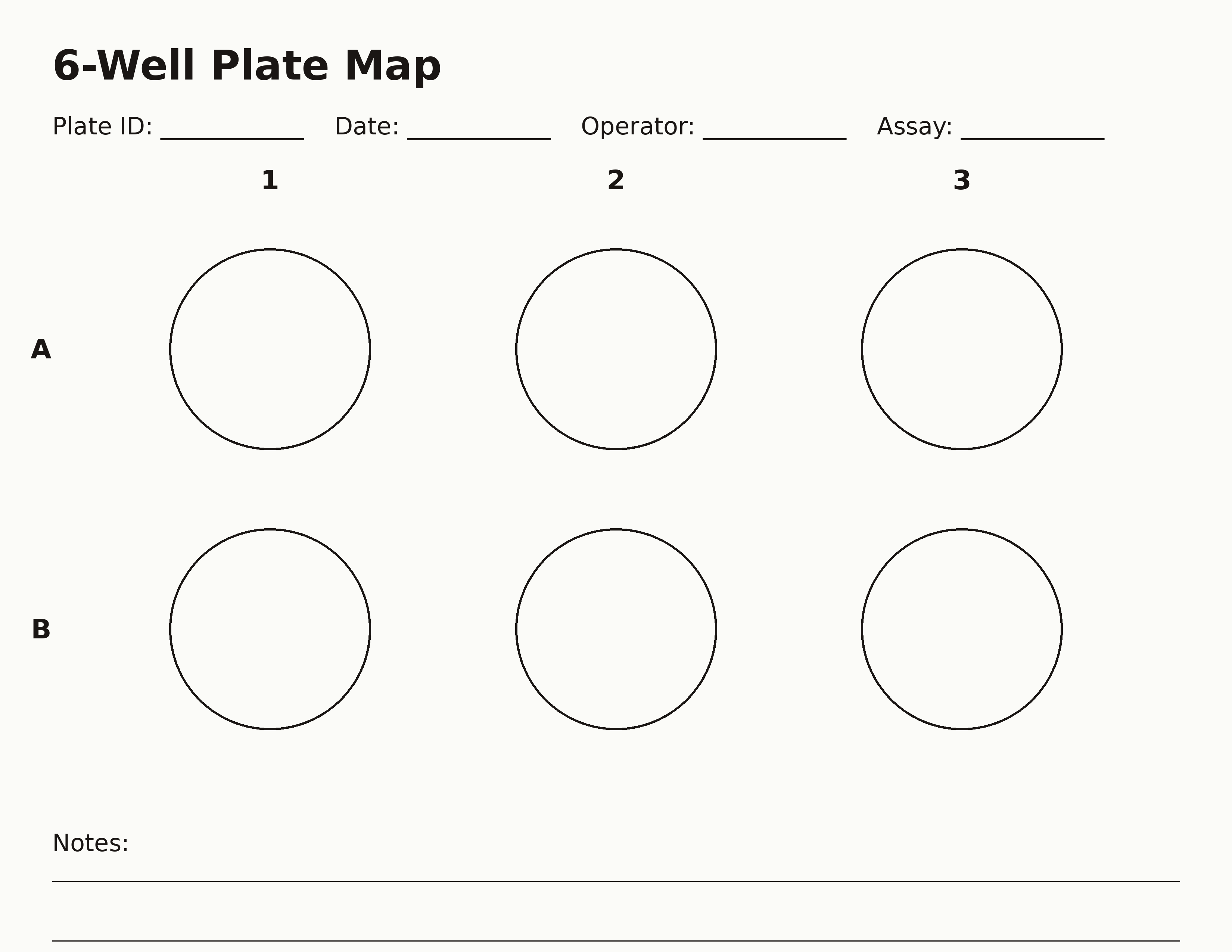
Open the online plate map maker Paint wells by group, then export the finished map as Excel or CSV.
Downloads
Plate map template (Excel, XLSX)
Plate map template (CSV)
Plate map template (printable PDF)
Plate map template (PNG image)
Sample list (Excel, XLSX)
Sample list (CSV)
Why a map matters at 6 wells
The map feels unnecessary at six wells and proves itself the first time a plate comes out of the incubator rotated, a pick needs its parent well, or a reviewer asks which well a figure came from. It takes thirty seconds: six addresses, the conditions, the density, the date. For cloning work the map is the lineage record; for culture work it is the difference between a result and an anecdote.
How to use the map
The map file is a grid, rows A to B and columns 1 to 3, with header fields for plate ID, date, operator, and assay. Mark the conditions first, then record seeding density and coating per well. The sample list file is the long form, one row per well for sample ID, contents, concentration, volume, and notes, which pastes cleanly into a lab notebook, a LIMS, or an analysis script.
Related guides
Common questions
Is the template compatible with Excel and Google Sheets?
Yes. The map and sample list download as Excel workbooks, and CSV versions sit at the same paths with a .csv extension. Excel, Google Sheets, and LibreOffice open either format directly.
What should I record for cloning work?
The parent well of every pick, the pick date, and where each expansion went. A clone without a recorded parent is a line without a history, and the map is the cheapest place that history can live.